Blog
Solar Project Insights
Industry challenges and engineering-led solutions for utility-scale and community solar projects.
The Five Biggest Solar Project Issues
The challenges that put projects, schedules, and long-term performance at risk.
1
 1 of 5 Solar Project Issues: Interconnection and Grid-Upgrade Uncertainty
Interconnection remains the largest obstacle facing both utility-scale and community solar projects.
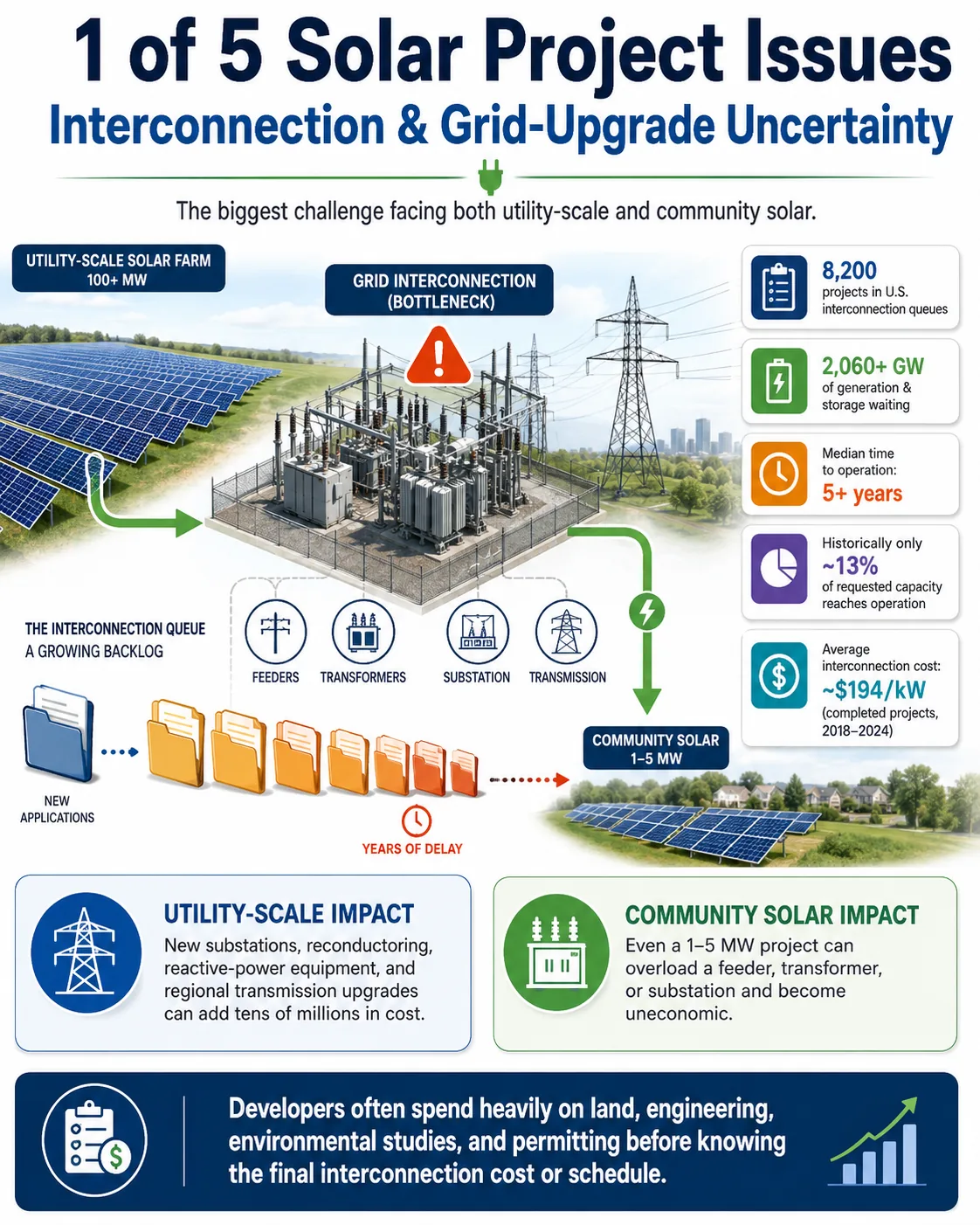
At the end of 2025, roughly 8,200 projects—representing more than 2,060 GW of generation and storage—were waiting in U.S. interconnection queues. Projects completed in 2025 spent a median of more than five years moving from interconnection request to commercial operation. Historically, only about 13% of requested capacity has ultimately reached operation.
But the problem is not just the wait. It is the uncertainty surrounding the final grid-upgrade cost.
Berkeley Lab found that completed projects from 2018 through 2024 averaged approximately $194 per kW in interconnection costs. Active and withdrawn projects received significantly higher estimates, largely because of required network upgrades.
Utility-scale solar
Transmission studies may trigger the need for new substations, reconductoring, reactive-power equipment, or major regional transmission upgrades. Those requirements can add tens of millions of dollars to a project.
Community solar
A 1–5 MW project may appear relatively small, but it can still overload a feeder, transformer, or substation. One unexpected upgrade can be enough to make the entire project financially unworkable.
The core challenge: developers often invest heavily in land control, engineering, environmental studies, and permitting before they know the final interconnection cost—or when the project will actually be allowed to connect.
Until interconnection becomes faster, more transparent, and more predictable, viable solar projects will continue to stall before construction ever begins.
2
 2 of 5 Solar Project Issues: Permitting, Zoning, Land Use, and Local Opposition
For utility-scale solar, permitting and local opposition are nearly as significant as interconnection when it comes to delaying or killing a project.
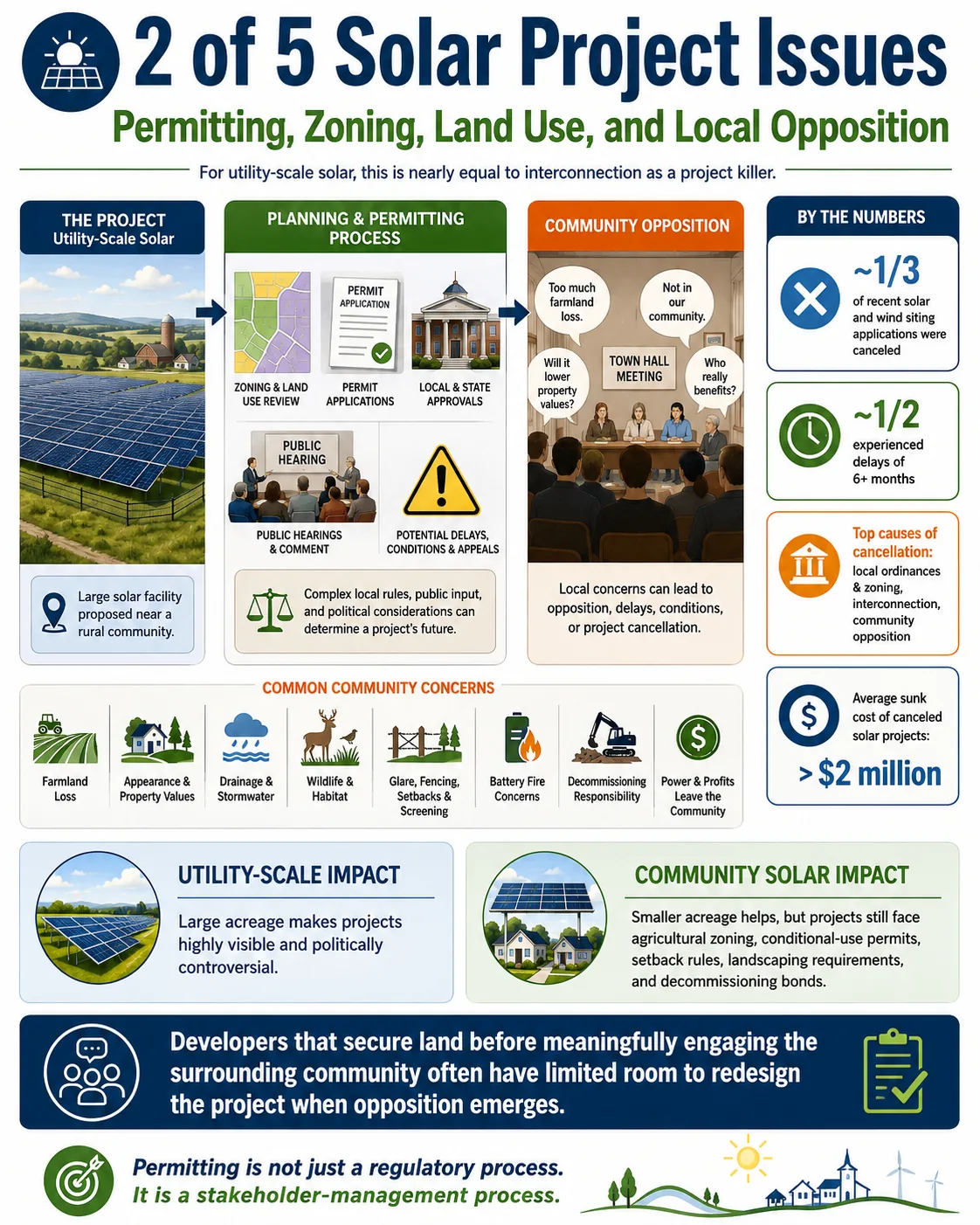
A Berkeley Lab survey of 123 renewable-development professionals found that approximately one-third of recent solar and wind siting applications were canceled, while about half experienced delays of six months or more. Local ordinances and zoning, interconnection challenges, and community opposition were among the leading causes.
For canceled solar projects, average sunk costs reportedly exceeded $2 million per project.
The challenge is not always that the written rules are impossible to meet. In many cases, opponents use public hearings, permitting proceedings, appeals, and litigation to delay, reshape, or stop a project entirely.
Common concerns
- Loss of farmland
- Appearance and property-value impacts
- Drainage and stormwater runoff
- Wildlife and habitat disruption
- Glare, fencing, setbacks, and screening
- Fire risk when battery storage is included
- Decommissioning responsibility
- The perception that the power and profits leave the community
For utility-scale solar, the amount of land involved makes the project highly visible and often politically controversial. Community solar typically requires less acreage, but it still faces agricultural zoning restrictions, conditional-use permits, setback requirements, landscaping standards, and decommissioning bonds.
The biggest strategic mistake developers can make is treating community engagement as something that happens after site control. By the time opposition appears, the developer may already be locked into a parcel, layout, and interconnection plan with little flexibility left to make meaningful changes.
Permitting is not just a regulatory process. It is a stakeholder-management process.
3
 3 of 5 Solar Project Issues: Changing Project Economics and Difficulty Obtaining Financing
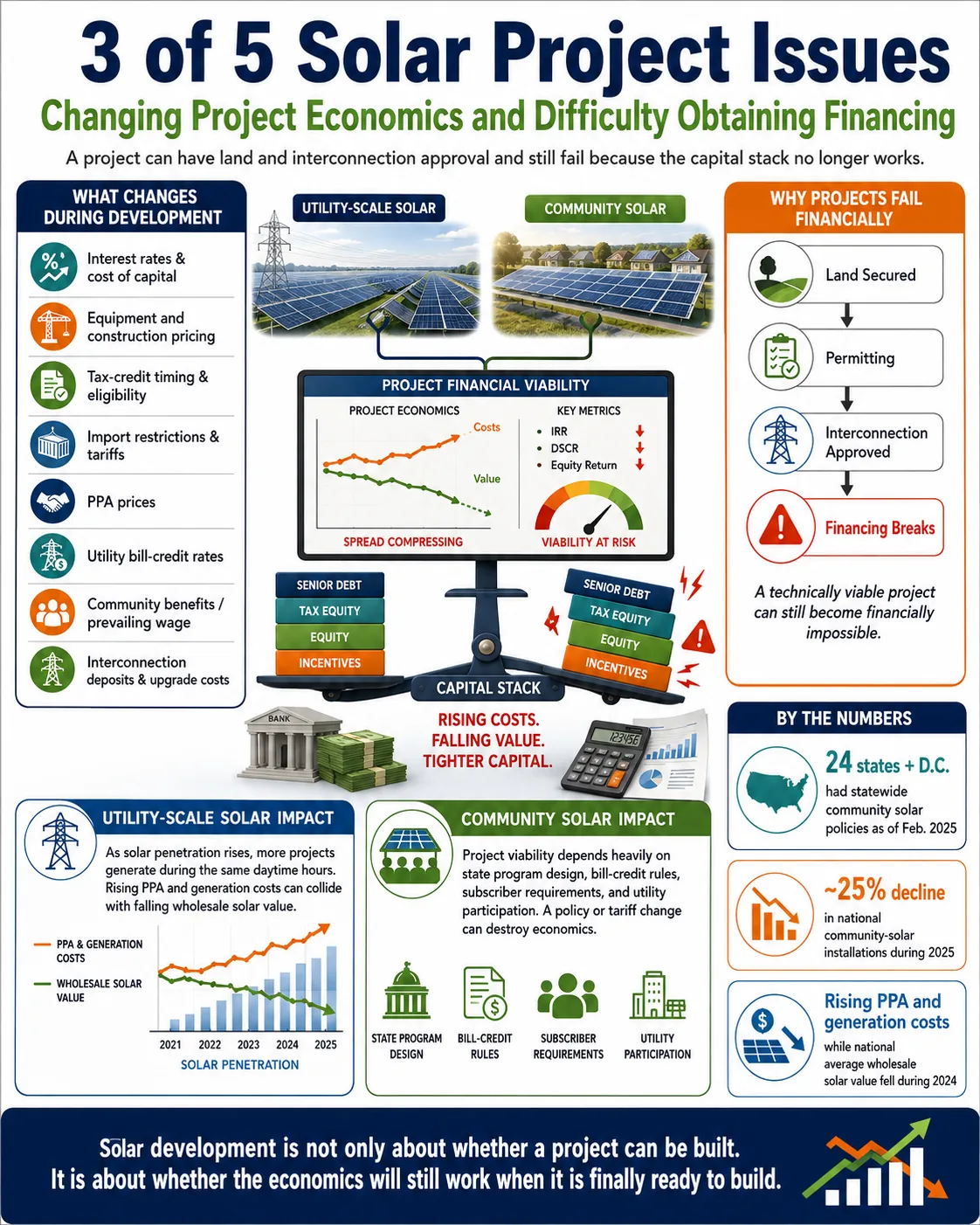
A solar project can secure land, complete permitting, and receive interconnection approval—and still never reach construction because the capital stack no longer works.
Solar projects are developed over multiple years, and the economics can change significantly between the original financial model and the final investment decision.
Key variables include
- Interest rates and the cost of capital
- Module, transformer, switchgear, steel, labor, and construction costs
- Tax-credit eligibility and timing
- Import restrictions and tariffs
- Power purchase agreement pricing
- Utility bill-credit rates
- Community-benefit and prevailing-wage requirements
- Interconnection deposits and grid-upgrade costs
A project that appeared financially viable when development began may no longer produce an acceptable return by the time it is ready to build.
Utility-scale solar
Solar projects tend to generate heavily during the same daytime hours. As more solar enters a market, that concentrated generation can suppress wholesale electricity prices during peak solar-production periods. Projects may cost more to build while the power they generate becomes less valuable during the hours when they produce the most.
Community solar
Community solar faces an additional layer of risk because its economics are highly dependent on state policy and utility-program design. Program capacity limits, bill-credit calculations, subscriber eligibility rules, low-income participation requirements, utility billing processes, and incentives can materially alter project economics.
The core issue is timing: developers make land, engineering, permitting, and interconnection investments today based on assumptions about financing, incentives, construction costs, and energy value years into the future.
4
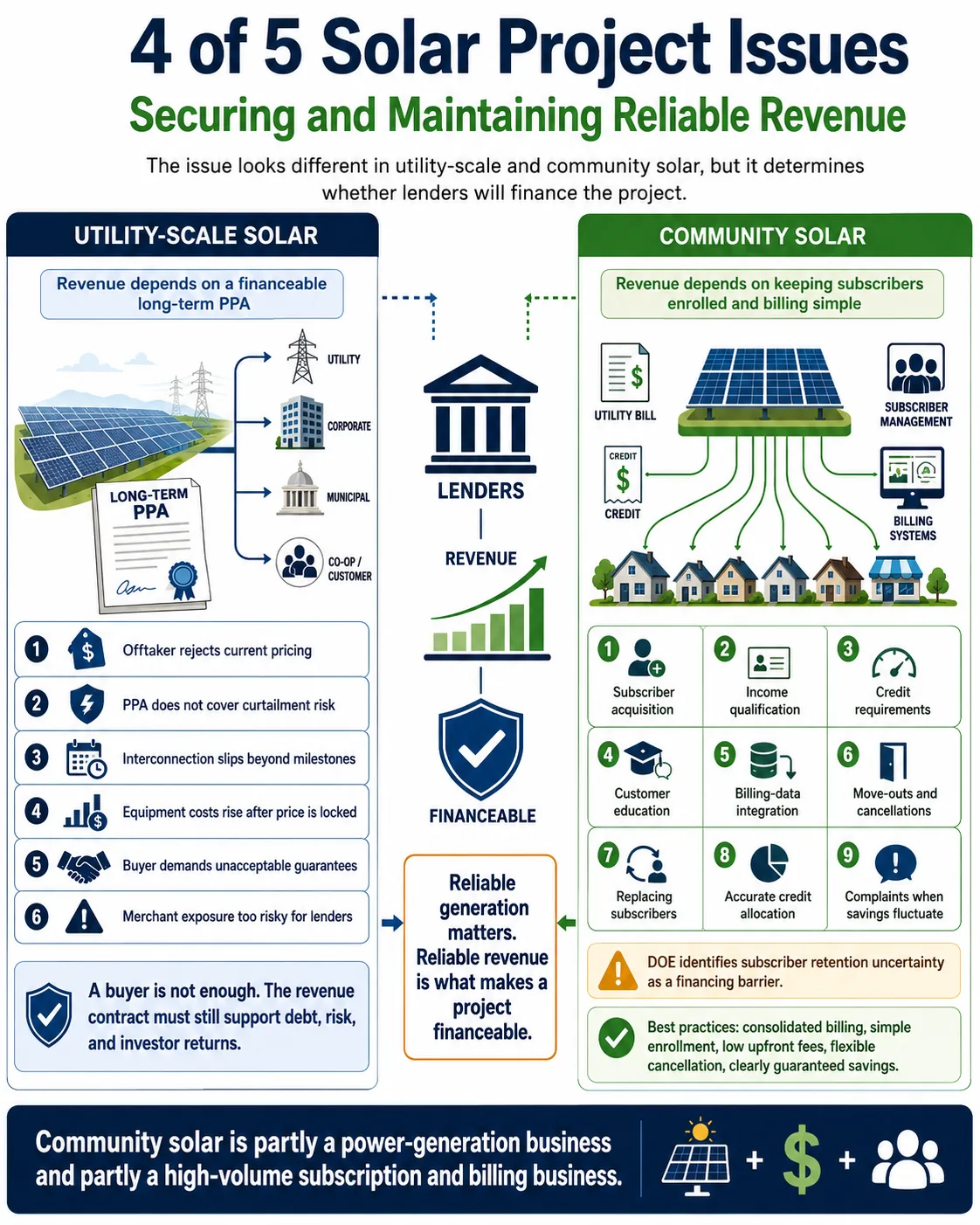 4 of 5 Solar Project Issues: Securing and Maintaining Reliable Revenue
A solar project does not become financeable simply because it can generate electricity. Lenders need confidence that the project will produce predictable revenue over the life of the financing.
Utility-scale solar
Utility-scale projects typically depend on a creditworthy utility, corporation, municipality, cooperative, or other buyer willing to sign a long-term power purchase agreement. The PPA is often the foundation of the project’s financing, but several issues can weaken that foundation:
- The offtaker will not accept current pricing
- The agreement does not adequately address curtailment
- Interconnection delays push the project beyond contractual milestones
- Equipment and construction costs increase after the PPA price is locked
- The buyer requires guarantees or damages the developer cannot accept
- Merchant-market exposure creates too much risk for lenders
Community solar
Community solar replaces one large buyer with hundreds—or sometimes thousands—of smaller subscribers. That creates an entirely different operating model involving subscriber acquisition, eligibility qualification, credit requirements, customer education, utility billing-data integration, move-outs and cancellations, subscriber replacement, accurate allocation of bill credits, and customer service when savings fluctuate.
DOE has identified uncertainty around maintaining subscriber enrollment as a community-solar financing barrier. Confusing billing makes the problem even harder.
In plain terms: community solar is partly a power-generation business and partly a high-volume subscription, billing, and customer-retention business.
Reliable generation matters. Reliable revenue is what makes the project financeable.
5
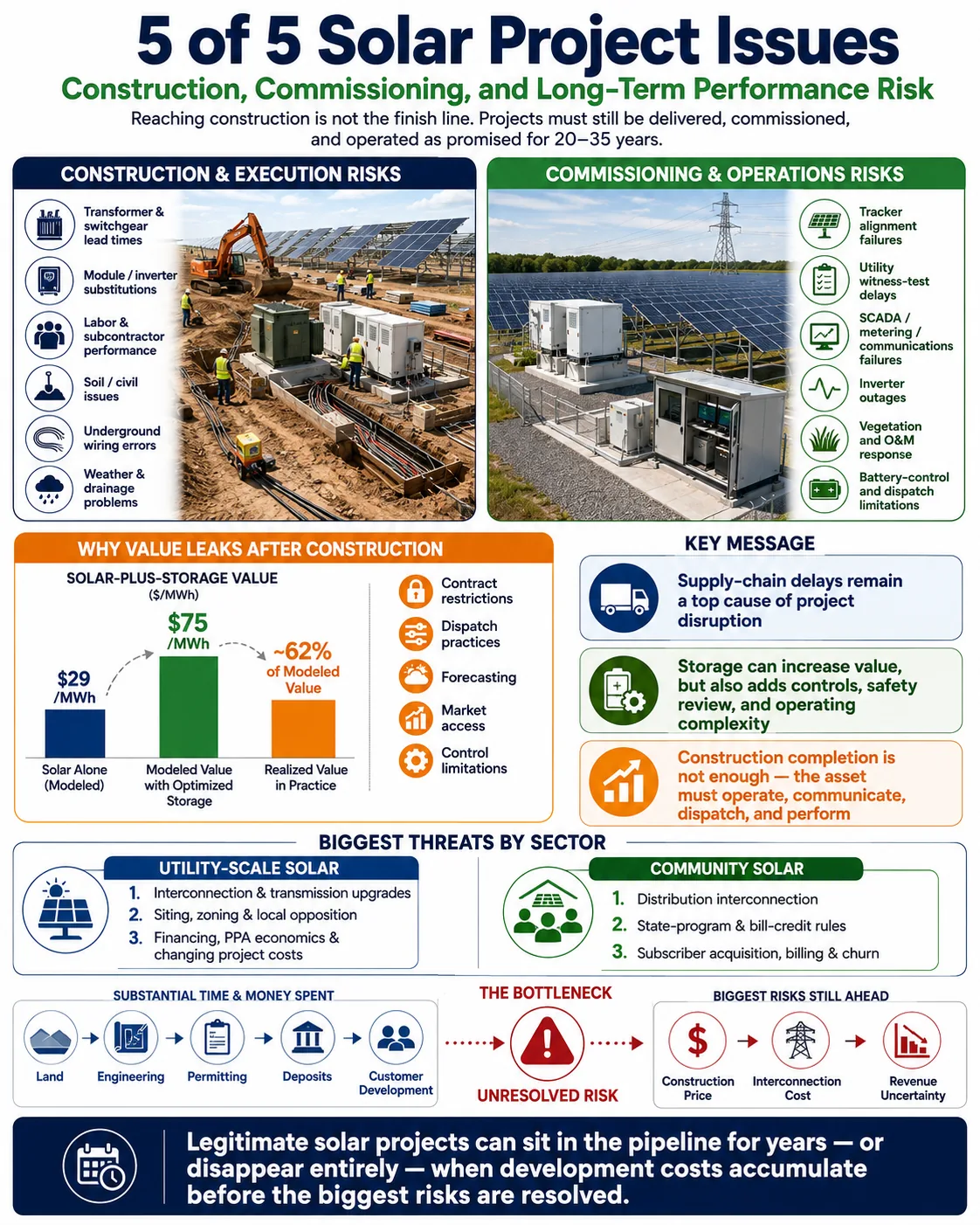 5 of 5 Solar Project Issues: Construction, Commissioning, and Long-Term Performance Risk
Reaching construction does not mean the risk is over. Developers still have to deliver the project at the cost, schedule, and output promised years earlier—and then keep it operating for decades.
Common execution risks include
- Transformer and switchgear lead times
- Module or inverter substitutions
- Labor availability and subcontractor performance
- Poor soil conditions and civil-work challenges
- Underground wiring damage or installation errors
- Tracker alignment and commissioning failures
- Utility witness-test delays
- Weather, drainage, and site-access problems
- SCADA, metering, communications, and data failures
- Module degradation, inverter outages, vegetation, and O&M response
- Battery-control and dispatch limitations on solar-plus-storage projects
Storage can improve project value, but it also adds equipment, controls, safety reviews, commissioning requirements, dispatch and forecasting requirements, and operating complexity.
Completing construction is not the finish line. The project must operate, communicate, dispatch, and produce as required for the next 20 to 35 years.
The fundamental industry challenge is that developers must spend substantial money before the largest risks are resolved. Land, engineering, permitting, deposits, customer acquisition, and development costs continue to accumulate while interconnection cost, approval timing, construction pricing, and final revenue remain uncertain.
How US Solar EBoS Integrations Helps
Where earlier electrical coordination and manufacturing discipline can remove avoidable execution risk.
1
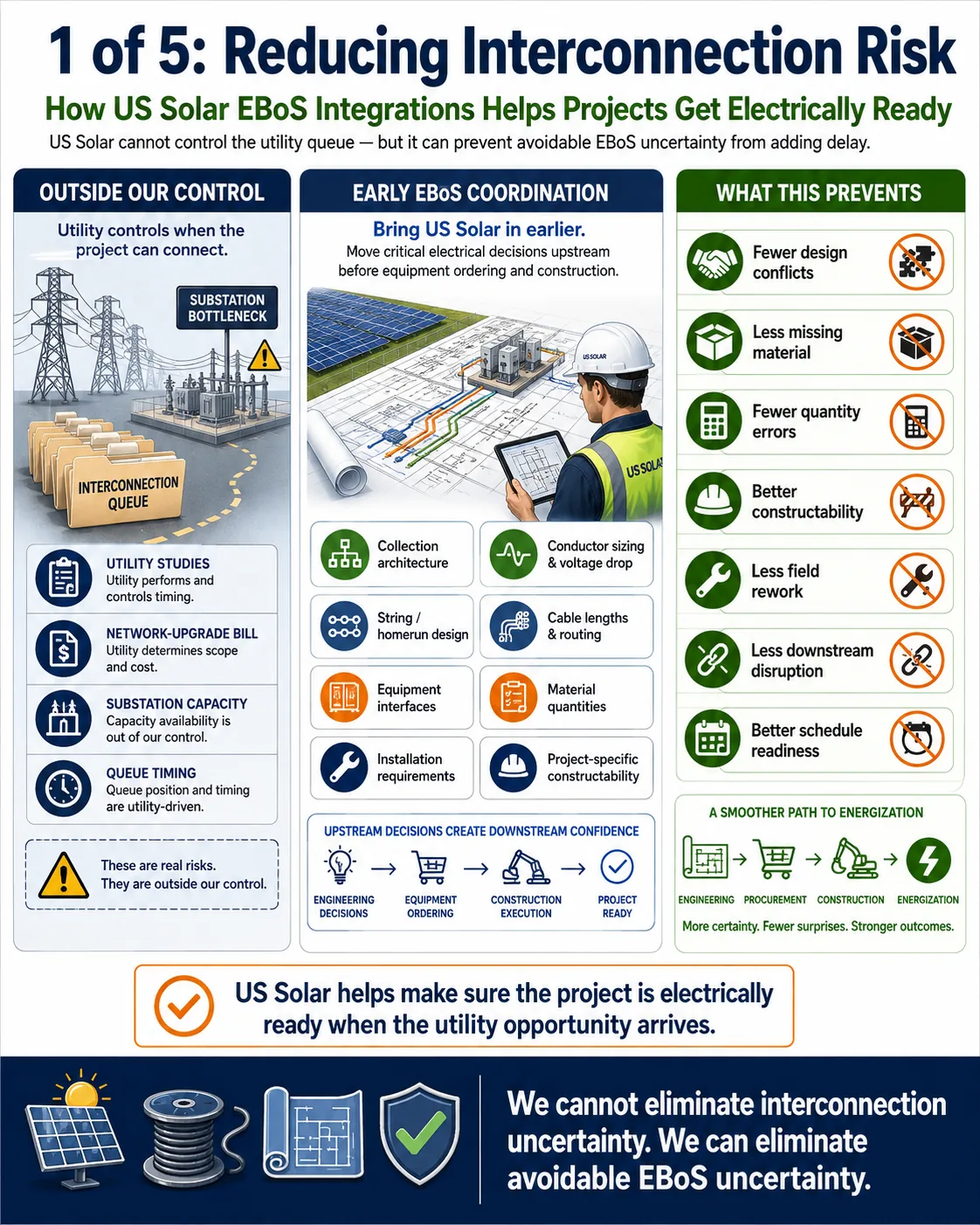 1 of 5: How US Solar EBoS Integrations Can Help Address Interconnection Risk
US Solar cannot move a project ahead in the utility queue. We cannot determine the network-upgrade bill, increase substation capacity, or control how long the utility takes to complete its studies.
But we can help ensure that the project’s electrical design does not become another source of delay.
Bringing US Solar EBoS Integrations into the project earlier can help establish
- Collection-system architecture
- Conductor sizing and voltage-drop assumptions
- String and homerun configurations
- Cable lengths and routing
- Equipment interfaces
- Material quantities
- Installation requirements
- Project-specific constructability
Those decisions become increasingly expensive to change once engineering is complete, equipment is ordered, and construction begins.
When EBoS is treated as a late-stage purchasing item, design conflicts, missing components, incorrect quantities, and incompatible field conditions may not appear until the project is already under schedule pressure.
Early coordination moves those decisions upstream—when they are still easier and less expensive to resolve.
US Solar cannot eliminate interconnection uncertainty. But we can help prevent avoidable EBoS uncertainty from being added to it.
The utility controls when the project can connect. Our job is to help make sure the project is electrically ready when that opportunity arrives.
2
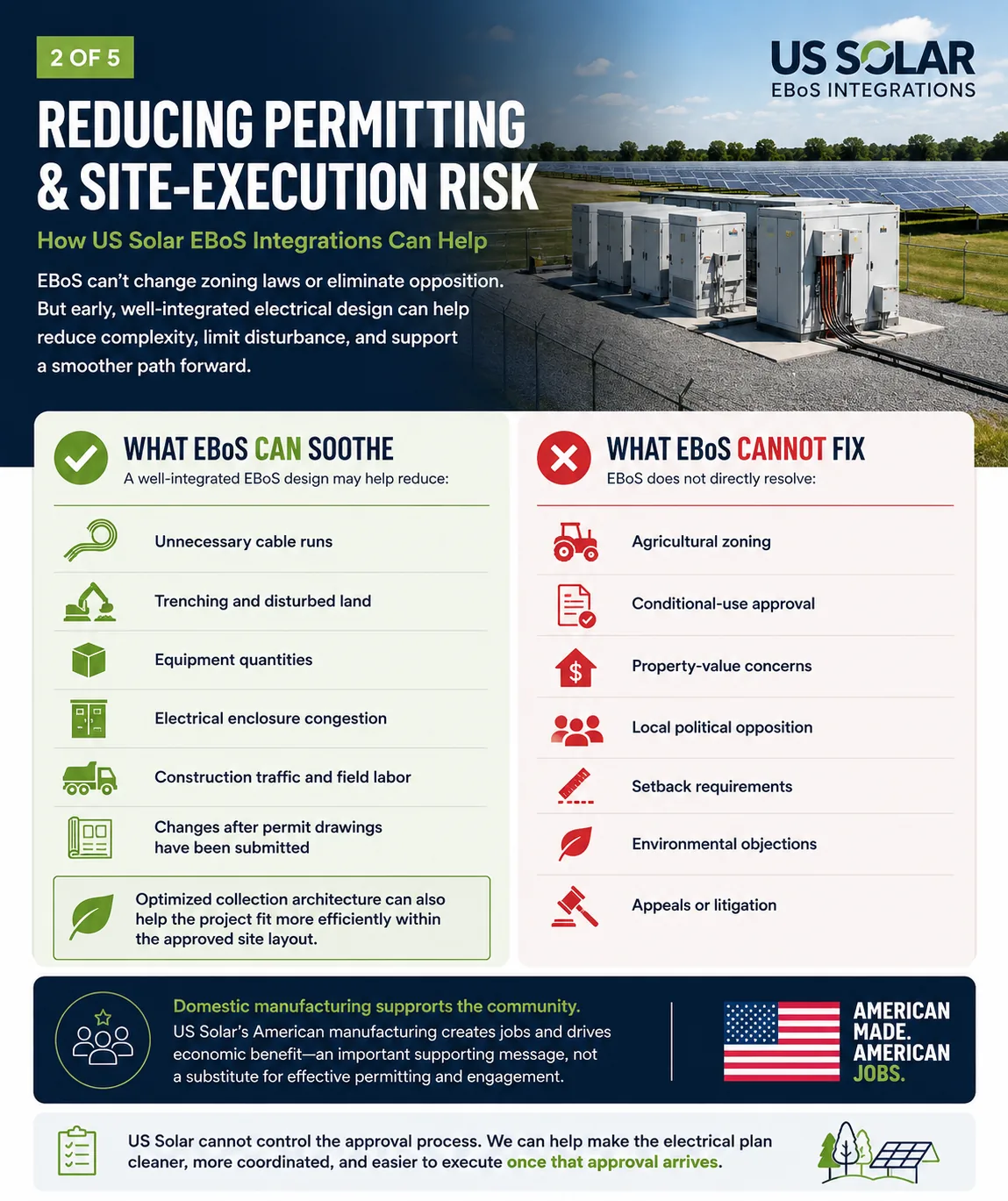 2 of 5: How US Solar EBoS Integrations Can Help Reduce Permitting and Site-Execution Risk
Permitting, zoning, land use, and local opposition are major challenges for solar developers.
US Solar EBoS Integrations cannot change a zoning ordinance, approve a conditional-use permit, or eliminate community opposition.
But a better-integrated electrical design can help reduce the amount of unnecessary complexity introduced into the project.
Early EBoS coordination can help reduce
- Unnecessary cable runs
- Trenching and disturbed land
- Excess equipment quantities
- Electrical enclosure congestion
- Construction traffic and field labor
- Changes after permit drawings have already been submitted
Optimized collection architecture can also help the electrical system fit more efficiently within the approved site layout.
That matters because once permits are issued, changes can become expensive. A late electrical redesign may affect trenching, equipment locations, access routes, drainage plans, construction sequencing, and other elements that have already gone through review.
US Solar’s domestic manufacturing operation can also support a broader community-benefit story around American manufacturing and regional employment—but that is a supporting benefit, not a substitute for effective permitting and community engagement.
The goal is not to claim that EBoS solves permitting. The goal is to make sure electrical design and construction complexity do not create additional permitting problems that could have been avoided.
3
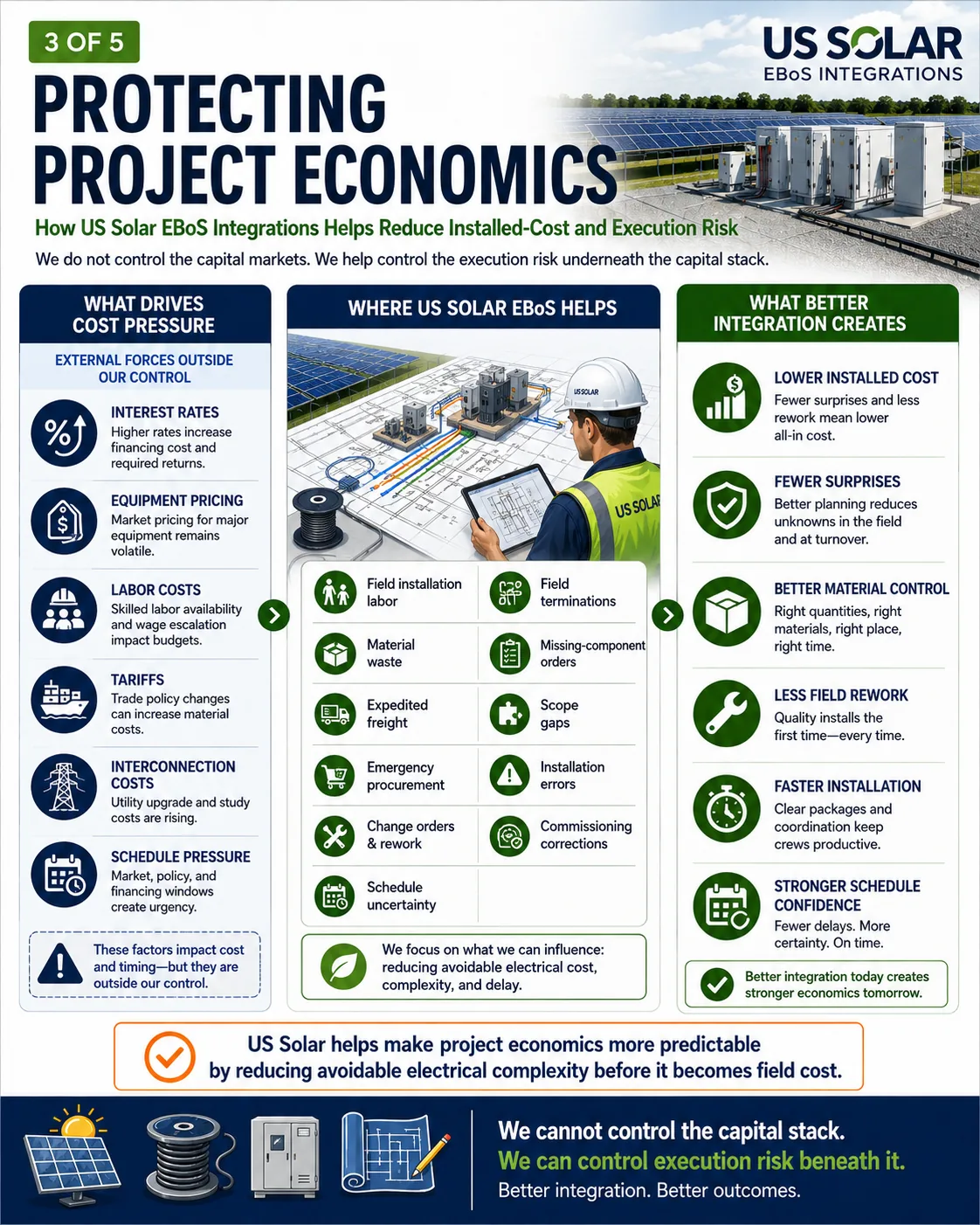 3 of 5: How US Solar EBoS Integrations Can Help Protect Project Economics
Solar project economics can change dramatically between the day a project is first modeled and the day construction begins. Interest rates move. Equipment pricing changes. Labor costs rise. Tariffs shift. Interconnection costs increase.
US Solar EBoS Integrations cannot control those external financial pressures. But we can help control part of the project that is often underestimated: the installed cost and execution risk of the electrical balance of system.
Early EBoS integration can help reduce
- Field installation labor
- Field terminations and assembly
- Material waste
- Missing-component orders
- Expedited freight
- Scope gaps between suppliers
- Emergency procurement
- Installation errors
- Change orders and rework
- Commissioning corrections
- Schedule uncertainty
The important number is not simply the price of the wire, connector, or assembly. It is the total installed cost of engineering, procuring, delivering, installing, correcting, commissioning, and maintaining that electrical system.
Moving repeatable electrical work into a controlled manufacturing environment can reduce field variability and give EPCs a more predictable path from design through installation.
We do not control the capital markets. We help control the execution risk underneath the capital stack.
4
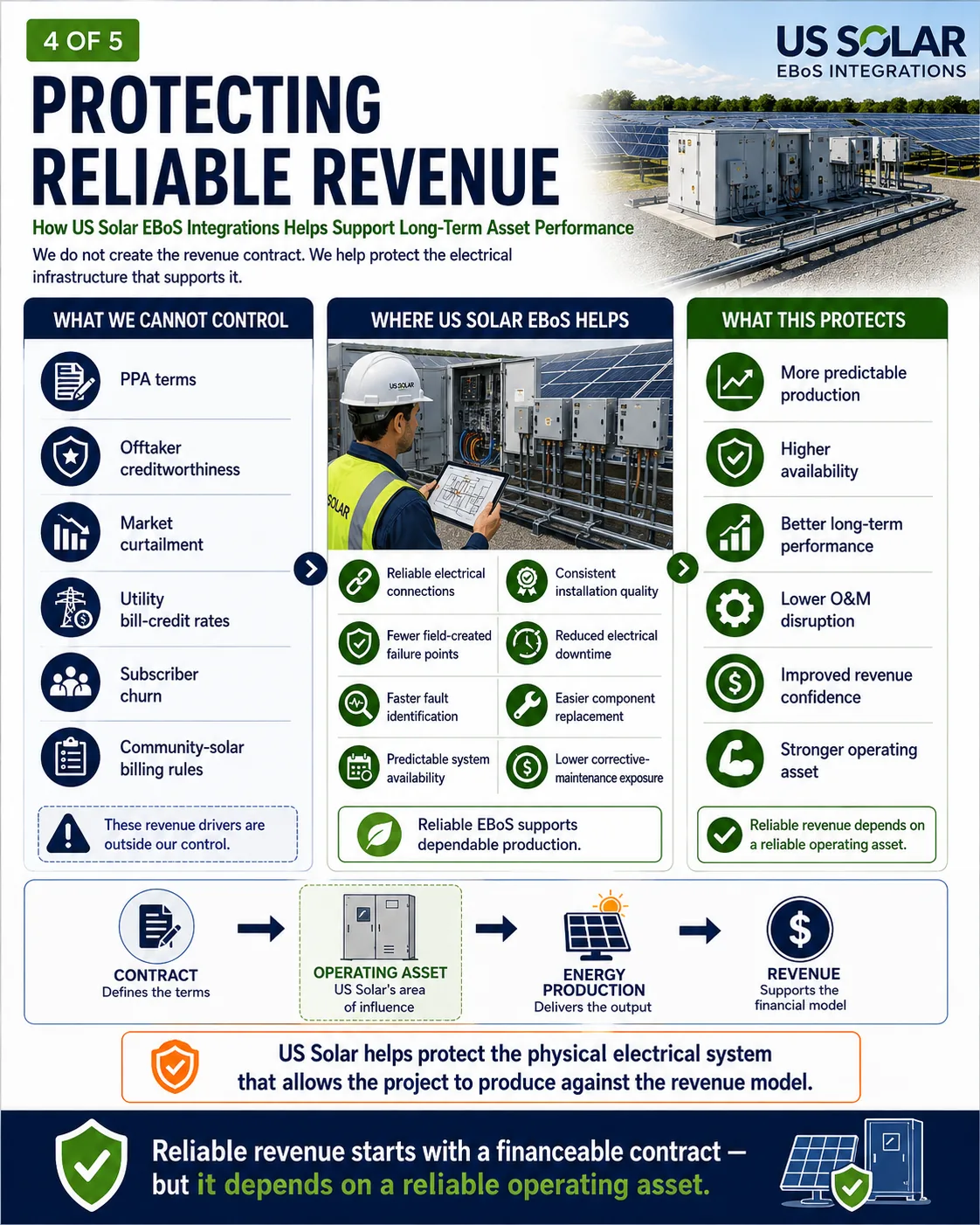 4 of 5: How US Solar EBoS Integrations Can Help Protect Reliable Revenue
A solar project can have a strong PPA, a creditworthy offtaker, and a solid financial model. But none of those generate revenue if the asset is not available to produce energy.
US Solar EBoS Integrations cannot secure the PPA, determine the offtaker’s creditworthiness, prevent market curtailment, set utility bill-credit rates, or keep community-solar subscribers enrolled.
What we can help protect is the electrical infrastructure that supports the project’s ability to generate.
A well-engineered and consistently manufactured EBoS system can help support
- Reliable electrical connections
- Consistent installation quality
- Fewer field-created failure points
- Reduced electrical downtime
- Faster fault identification
- Easier component replacement
- More predictable system availability
- Lower corrective-maintenance exposure
- Long-term operating performance
At utility scale, thousands of electrical connections have to perform reliably for decades. A small connection issue repeated across a large project can become a major O&M problem.
That is why EBoS should not be viewed only as a construction package. It is part of the long-term operating asset.
Reliable revenue starts with a financeable contract—but it depends on a reliable operating asset.
5
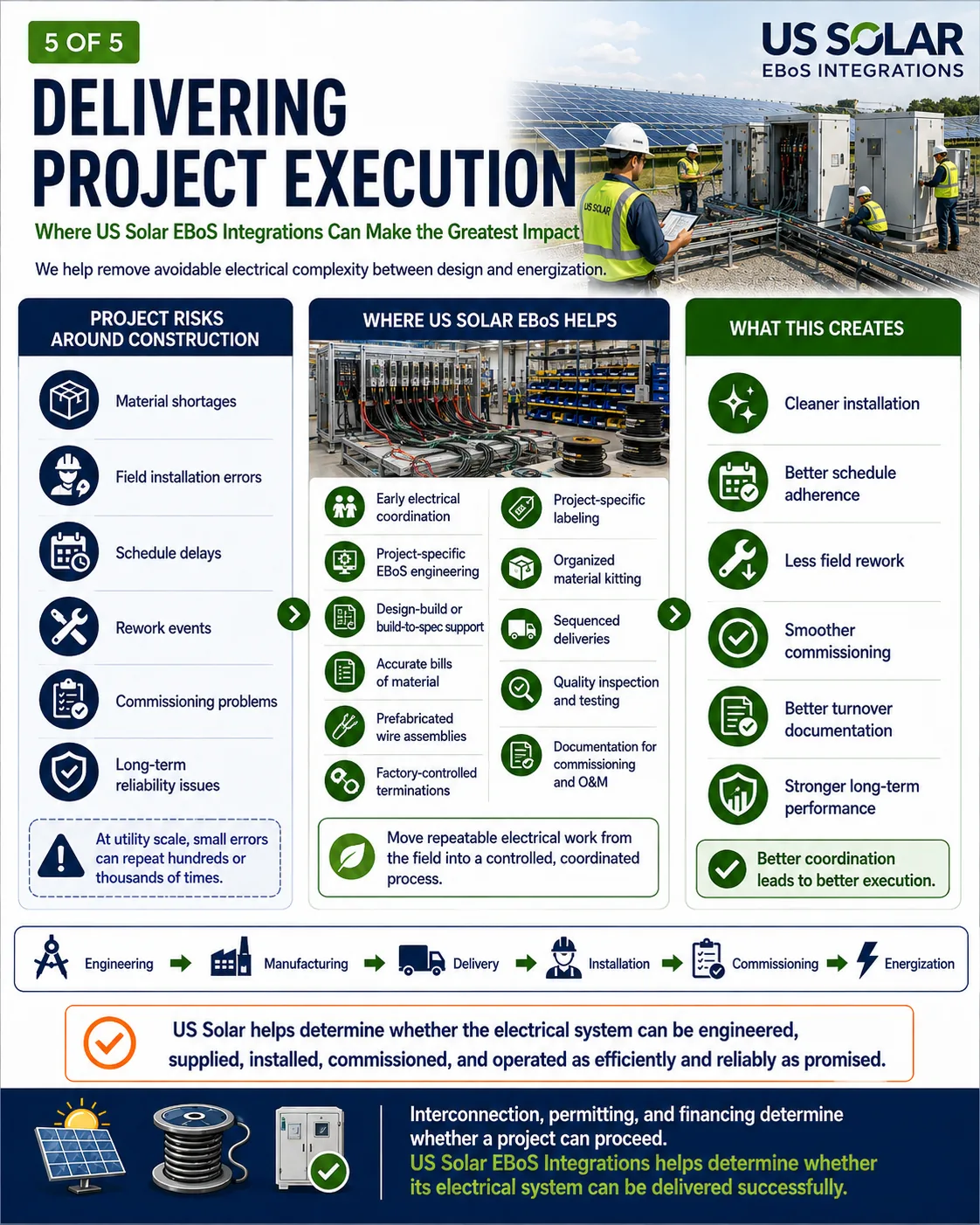 5 of 5: Where US Solar EBoS Integrations Can Make the Greatest Impact
Getting a solar project to construction is a major milestone. But construction is where years of engineering, procurement, pricing, and scheduling assumptions finally have to work in the real world.
This is where US Solar EBoS Integrations can make its most direct impact.
Our role can help support
- Early electrical coordination
- Project-specific EBoS engineering
- Design-build or build-to-spec execution
- Accurate bills of material
- Prefabricated wire assemblies
- Factory-controlled terminations
- Project-specific labeling
- Organized material kitting
- Sequenced project deliveries
- Quality inspection and testing
- Reduced field assembly
- Replacement and spare-part planning
- Documentation for commissioning and O&M
At utility scale, small mistakes can be repeated hundreds or thousands of times. One incorrect cable assumption, connector selection, material quantity, or field-installation detail can become a material shortage, schedule delay, rework event, commissioning problem, or long-term reliability issue.
Early coordination allows more of those decisions to be resolved before materials reach the field. Factory-controlled assembly also moves repeatable electrical work away from unpredictable site conditions and into a more consistent production environment.
Interconnection, permitting, and financing determine whether a project can proceed. US Solar EBoS Integrations helps determine whether the electrical system can be engineered, supplied, installed, commissioned, and operated as efficiently and reliably as promised.
Bring EBoS into the project earlier.
Coordinate the electrical system before avoidable design, procurement, and field issues become project delays.
Contact US Solar 618-212-2020